

UNESCO Recommendation on the Ethics of AI

Among global AI policy documents, one stands out for the number of countries behind it. The UNESCO Recommendation on the Ethics of Artificial Intelligence was adopted by all of UNESCO's member states, giving it unusually broad legitimacy. It treats AI not only as a technical matter but as a question of human dignity, inclusion and the shared future of societies.
This guide explains what the Recommendation says, its values and principles, its policy action areas and what it means for organizations. Readers who want practical training on responsible AI can also consider the Certified Responsible AI Expert certification from Universal Business Council.

What Is the UNESCO Recommendation on the Ethics of AI?
The Recommendation is a global normative instrument adopted by UNESCO's General Conference in November 2021. It was endorsed by 193 member states and is regarded as the first worldwide standard-setting document on AI ethics. It is not a binding treaty. Instead, it sets out shared values and principles and urges states to turn them into national laws, policies and practices.
It applies to AI systems across their lifecycle, from research and design to deployment and use, and it addresses governments, private companies, researchers and civil society. Its scope is wide, covering education, culture, science, communication, the environment, health and the economy.
Core Values
The Recommendation grounds AI ethics in four values:
Respect, protection and promotion of human rights, fundamental freedoms and human dignity
Environment and ecosystem flourishing
Ensuring diversity and inclusiveness
Living in peaceful, just and interconnected societies
These values frame everything else. They emphasize that AI should serve people and the planet and that inequalities and cultural diversity must be protected.
The Ten Principles
From the values, the Recommendation draws ten principles that guide AI actors.
Safety, Fairness and Privacy
The principle of proportionality and do no harm says AI use should be limited to what is necessary for a legitimate aim, backed by risk assessment. Safety and security call for avoiding unwanted harms and vulnerabilities to attack. Privacy and data protection must be respected across the lifecycle, and fairness and non-discrimination require inclusive approaches to ensure benefits are accessible to all.
Oversight, Transparency and Accountability
Human oversight and determination means that people remain ultimately responsible and accountable, and that life-and-death decisions should not be left to AI. Transparency and explainability call for appropriate levels of openness, while responsibility and accountability require auditability, traceability and mechanisms for redress.
Society, Sustainability and Governance
Sustainability asks for assessment of AI's effects on environmental and social goals. Awareness and literacy encourage public education and engagement. Multi-stakeholder and adaptive governance and collaboration stresses participation by many groups and respect for international law and national sovereignty.
The Eleven Policy Action Areas
The Recommendation goes beyond principles by listing areas where states should act. They include ethical impact assessment, ethical governance and stewardship, data policy, development and international cooperation, environment and ecosystems, gender, culture, education and research, communication and information, economy and labor and health and social well-being. For businesses, these areas hint at where regulation and expectations may grow, particularly on impact assessment, data governance, gender equality and environmental effects.
Tools: Readiness and Impact Assessment
UNESCO has developed practical tools to support implementation. The Readiness Assessment Methodology helps countries gauge how prepared they are to implement the Recommendation, while the Ethical Impact Assessment offers a structured approach, mainly for public-sector projects, to identify benefits, risks and mitigations. Organizations can adapt the same idea by running impact assessments on high-stakes systems before launch.
What It Means for Organizations
Companies are not legally bound by the Recommendation directly, but its influence reaches them through national policy, procurement rules and stakeholder expectations. It is a useful lens for internal ethics programs, particularly because it highlights topics that technical frameworks sometimes underplay, such as cultural diversity, gender, labor impacts and environmental cost.
Practical Steps
Adopt a values statement that reflects human rights, inclusion and sustainability
Run ethical impact assessments on systems that affect people's opportunities or rights
Strengthen data governance, privacy and non-discrimination controls
Maintain human oversight and clear accountability for consequential decisions
Build AI literacy among employees and users
Consider environmental impact when choosing and scaling models
Success depends on the people carrying this work out. Hiring teams often verify credentials for roles in ethics, risk and compliance, and HireValid can help confirm qualifications and experience.
UNESCO Compared with Other Frameworks
The OECD AI Principles are concise and aimed at policy alignment among member economies, while the UNESCO Recommendation is broader, more explicit on human rights, gender, culture and environment and includes detailed policy actions. The EU AI Act is binding law, and the NIST AI RMF and ISO/IEC 42001 provide operational practices. Organizations can use UNESCO for the ethical vision and the others for implementation.
Technical literacy helps ethics teams challenge system design in a meaningful way, and short tech certifications can help non-engineers build it. Ethical communication matters too, so a Digital Marketing Course can help teams explain AI features honestly and respectfully.
Finally, it pays to follow how AI interacts with other technologies. Deep Tech Certifications offer helpful background for that wider view.
Conclusion
The UNESCO Recommendation offers a human-centered, globally endorsed vision of AI ethics built on four values, ten principles and eleven policy areas. Treat it as the ethical foundation of your program, use impact assessment to put it into practice and pair it with operational frameworks. The FAQs below answer common questions.
Frequently Asked Questions
What is the UNESCO Recommendation on AI ethics?
A global standard on AI ethics adopted by UNESCO member states in 2021.
Is it legally binding?
No, it is a normative instrument that guides national and organizational action.
How many countries adopted it?
All 193 UNESCO member states.
What are its core values?
Human rights and dignity, environmental flourishing, diversity and inclusiveness and peaceful societies.
How many principles does it have?
Ten principles.
What is proportionality and do no harm?
AI use should be necessary for a legitimate aim and should avoid harm.
What does human oversight mean in the Recommendation?
People remain responsible and accountable, especially for life-and-death decisions.
What are the policy action areas?
Eleven areas, including data, education, gender, environment, health and labor.
What is the Readiness Assessment Methodology?
A UNESCO tool that helps countries gauge their readiness to implement the Recommendation.
What is an ethical impact assessment?
A structured review of an AI project's benefits, risks and mitigations.
Does it address the environment?
Yes, it includes environment and ecosystem flourishing and calls for assessing AI's environmental impact.
Does it address gender equality?
Yes, it contains a dedicated policy area on gender.
How does it differ from the OECD principles?
It is broader, with more focus on human rights, culture and policy actions.
Does it affect private companies?
Indirectly, through national policy, procurement and stakeholder expectations.
How does it relate to the EU AI Act?
The Act is binding law, while UNESCO provides an ethical vision with similar values.
Can businesses use it as a framework?
Yes, as the ethical foundation of an internal AI program.
What is AI literacy in this context?
Public and workforce education so people understand and can engage with AI.
Does it cover generative AI?
Its principles apply broadly to AI systems, including newer technologies.
What is multi-stakeholder governance?
Governance that involves governments, industry, academia and civil society.
How should organizations start applying it?
Adopt a values statement and run impact assessments on high-stakes systems.
Related Articles
View All
Artificial Intelligence
Responsible AI Training for Businesses: How to Upskill Teams in AI Ethics and Governance
Learn how businesses can train and upskill their teams in responsible AI practices. Explore how structured training helps employees understand AI ethics, governance, risk management, data privacy, bias prevention, and accountability while supporting the safe and effective use of AI across the organization.
Artificial Intelligence
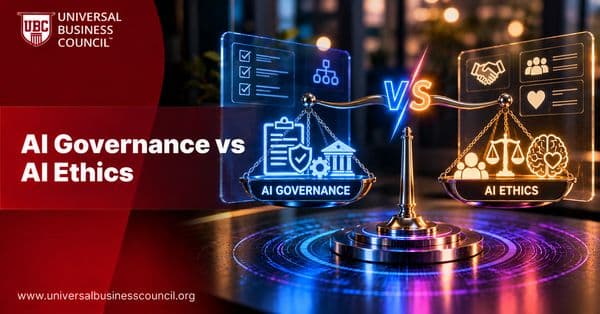
AI Governance vs AI Ethics: Differences, Use Cases and Implementation
Understand the differences between AI governance and AI ethics, including their principles, frameworks, use cases, and implementation approaches. Learn how organizations combine ethical guidelines with governance policies to manage AI risks, ensure accountability, promote transparency, and support responsible AI adoption.
Artificial Intelligence
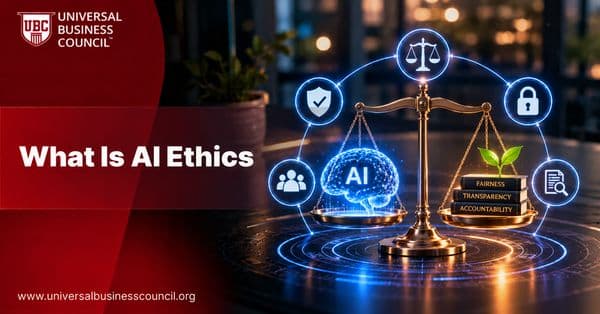
What Is AI Ethics? Principles, Challenges and Business Applications
Understand what AI ethics means and explore its core principles, key challenges, and business applications. Learn how fairness, transparency, accountability, privacy, and responsible decision-making help organizations develop and use artificial intelligence ethically while building trust and reducing risks.
Trending Articles
The Role of Blockchain in Ethical AI Development
How blockchain technology is being used to promote transparency and accountability in artificial intelligence systems.
AWS Career Roadmap
A step-by-step guide to building a successful career in Amazon Web Services cloud computing.
Top 5 DeFi Platforms
Explore the leading decentralized finance platforms and what makes each one unique in the evolving DeFi landscape.