

5 Reasons Why Your PPC Campaigns Fail?
 Smita
Smita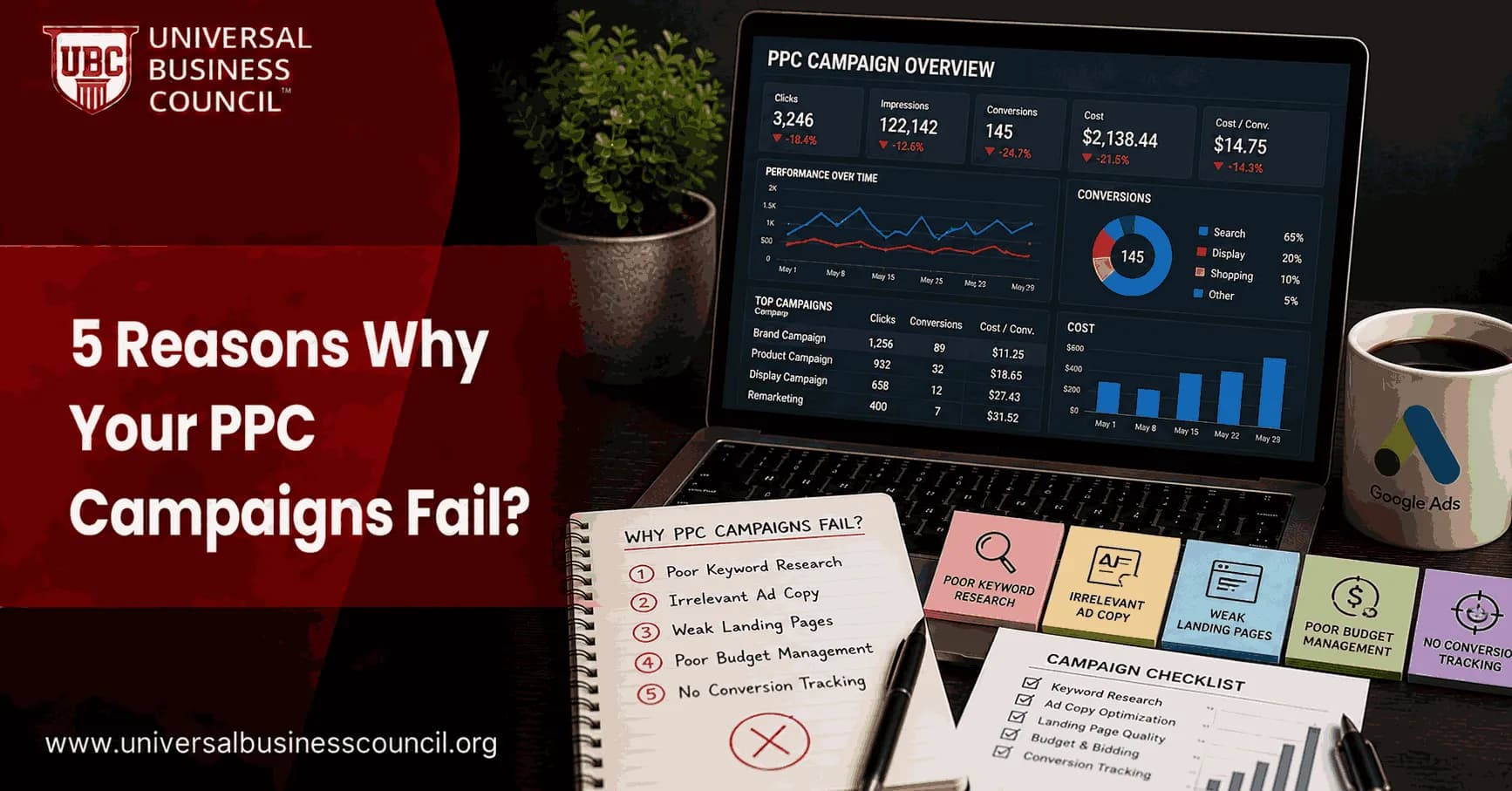
Pay per click advertising promises fast visibility, measurable traffic, and quick conversions, yet a large number of campaigns quietly burn through budget without delivering real results. Business owners often assume the platform is at fault, when in reality the problem usually lies in strategy, structure, or execution. Understanding these gaps is exactly what separates a Certified Google Ads Expert from someone simply clicking buttons inside an ad account. Before spending another rupee or dollar on ads, it helps to understand the most common reasons PPC campaigns underperform and how to fix them.
1. Poor Keyword Research and Match Type Selection
One of the earliest and most damaging mistakes in PPC advertising is weak keyword planning. Many advertisers pick broad, generic terms without analyzing search intent, competition, or negative keywords. This leads to wasted impressions on users who were never going to convert. A campaign built on guesswork instead of data rarely survives long term. This is where the training behind a Certified Digital Marketing Expert becomes valuable, since proper keyword segmentation, match type strategy, and intent mapping are core parts of that skill set. Without this foundation, even a well-designed ad can end up showing to the wrong audience entirely.

2. Weak Landing Page Experience
Traffic alone does not create conversions. A large share of PPC budgets is lost because the ad promises one thing while the landing page delivers something else. Slow load times, cluttered design, unclear calls to action, and mismatched messaging all push potential customers away within seconds. Search engines and AI powered answer systems increasingly reward pages that are fast, relevant, and structured clearly, which means landing page quality now directly affects both paid and organic visibility. Advertisers who treat the landing page as an afterthought are essentially paying to lose customers.
3. Ignoring Audience Segmentation and Targeting Settings
Running the same ad to everyone, regardless of location, device, demographic, or buying stage, is a common reason campaigns fail to scale profitably. Without proper segmentation, budget gets spread thin across users who have very different needs and intent levels. Skills gained through a Deep Tech Certification often help marketers understand how automation, machine learning bidding, and audience signals work together inside modern ad platforms, allowing for smarter targeting instead of a one size fits all approach. Refining audience settings regularly is not optional anymore, it is a requirement for sustainable performance.
In the middle of learning technical skills like these, it is worth noting that structured technology education is becoming just as important for the next generation as it is for marketers today. Technology Skills & Education Schools and parents are increasingly looking for ways to introduce children to technology in a structured and meaningful way. The World Tech Olympiad provides an opportunity for students to explore AI, coding, robotics, cybersecurity, and computational thinking while building confidence and problem-solving skills.
4. Neglecting Conversion Tracking and Data Analysis
Many advertisers set up a campaign, launch it, and check back weeks later without ever verifying that conversion tracking is working correctly. Broken tracking pixels, duplicate conversion counts, or missing goal setups lead to decisions based on incomplete or misleading data. Optimizing a campaign without accurate numbers is like driving with a broken speedometer. Regular audits of tracking setups, attribution models, and reporting dashboards are essential to know what is actually working and what is quietly draining the budget.
5. Lack of Continuous Optimization and Testing
PPC is not a set it and forget it channel. Campaigns that are launched once and left untouched inevitably decline in performance as competition shifts, seasonality changes, and audience behavior evolves. Failing to test ad copy variations, adjust bids, refresh creatives, or pause underperforming keywords leads to stagnation. Long term success in paid advertising depends on ongoing refinement, and this is exactly the kind of practical, hands on skill validated through a Tech Certification, which confirms that a marketer can apply current tools and platform updates rather than relying on outdated methods.
PPC failure rarely comes down to a single mistake. It is usually a combination of weak research, poor user experience, loose targeting, unreliable data, and a lack of ongoing testing. Addressing each of these areas with a structured, informed approach is what turns a struggling ad account into a consistently profitable one.
FAQs
1. Why do PPC campaigns fail?
PPC campaigns can fail because of poor targeting, weak ad copy, irrelevant keywords, ineffective landing pages, or incorrect conversion tracking. Without regular monitoring and optimization, even a well-funded campaign can generate clicks without producing valuable results.
2. What is the most common reason for PPC campaign failure?
Poor targeting is one of the most common reasons PPC campaigns underperform. If ads are shown to people who are unlikely to need the product or service, the campaign may generate impressions and clicks without enough conversions.
3. How does poor keyword selection affect PPC campaigns?
Choosing overly broad, irrelevant, or highly competitive keywords can waste advertising budget. Marketers should select keywords that closely match their products, services, audience intent, and campaign objectives.
4. Why is irrelevant ad copy a problem in PPC advertising?
Ad copy that does not match the user's search intent may receive fewer clicks or attract people who are unlikely to convert. Effective PPC ads should clearly communicate the offer and align closely with the keywords and landing page.
5. How can poor landing pages cause PPC campaigns to fail?
A landing page that is slow, confusing, difficult to navigate, or unrelated to the advertisement can cause visitors to leave without converting. The landing page should provide a consistent experience and make the desired action easy to complete.
6. Can a low PPC budget cause a campaign to fail?
A limited budget can restrict the amount of traffic and conversion data a campaign can generate, but a high budget does not guarantee success. Campaign efficiency, audience quality, keyword selection, bidding strategy, and conversion rates are also important.
7. Why is conversion tracking important for PPC campaigns?
Conversion tracking helps advertisers determine which clicks and campaigns produce valuable actions such as purchases, leads, or sign-ups. Without reliable tracking, marketers may struggle to identify what is working and where the advertising budget is being wasted.
8. How does poor audience targeting affect PPC performance?
Poor targeting can expose advertisements to users who have little interest or purchasing intent. Refining audiences based on relevant characteristics, search intent, behavior, and previous interactions can help improve campaign efficiency.
9. Why do PPC campaigns get clicks but no conversions?
High clicks with low conversions can indicate a mismatch between the advertisement, keyword, audience, and landing page. It may also suggest that the offer is not compelling enough or that users are being attracted with a message that does not match what they find after clicking.
10. How can negative keywords improve PPC campaigns?
Negative keywords prevent ads from appearing for searches that are unlikely to produce useful results. Adding appropriate negative keywords can reduce irrelevant traffic and help advertisers focus their budget on more qualified searches.
11. How does poor ad relevance affect PPC campaigns?
When an ad is not closely related to the user's search or audience interest, performance can suffer. Improving keyword-to-ad relevance and ensuring the landing page delivers on the ad's promise can create a more consistent user experience.
12. Why is choosing the wrong bidding strategy a PPC mistake?
Different bidding strategies are designed for different campaign objectives. Using a strategy that does not match the available conversion data, budget, or business goal can lead to inefficient spending and weaker results.
13. How does lack of PPC testing lead to campaign failure?
Running only one version of an advertisement makes it difficult to know which messaging or creative performs best. Testing different headlines, descriptions, offers, landing pages, audiences, or other campaign elements can provide data for optimization.
14. Why should PPC campaigns be regularly optimized?
PPC performance can change as competition, search behavior, audience response, and costs change. Regular optimization helps marketers identify underperforming keywords, ads, audiences, and landing pages and allocate budget more effectively.
15. Can poor ad scheduling hurt PPC performance?
Yes. If advertisements are shown during periods when the target audience is less likely to convert, budget may be spent inefficiently. Analyzing performance by day and time can help marketers determine whether scheduling adjustments are appropriate.
16. How does a poor-quality offer affect PPC results?
Even well-targeted advertisements may struggle if the product, service, pricing, or offer does not provide enough value to the audience. Improving the offer and clearly communicating its benefits can help increase conversion potential.
17. What PPC metrics should marketers monitor?
Important metrics can include impressions, clicks, click-through rate, cost per click, conversion rate, cost per conversion, and return on ad spend. The most important metrics depend on whether the campaign is focused on awareness, traffic, leads, sales, or another objective.
18. How can marketers reduce wasted PPC spending?
Marketers can reduce waste by improving keyword targeting, using negative keywords, refining audiences, improving ad relevance, monitoring search terms, and optimizing bids and budgets. Strong conversion tracking is also essential for identifying where spending produces meaningful results.
19. What are the five main reasons PPC campaigns fail?
Five common reasons are poor keyword selection, incorrect audience targeting, weak ad copy, ineffective landing pages, and inadequate tracking or optimization. Addressing these areas can help advertisers improve campaign efficiency and conversion performance.
20. How can you fix an underperforming PPC campaign?
Start by reviewing the campaign objective, targeting, search terms, keywords, ad relevance, landing page experience, conversion tracking, and performance by device and audience. Use the data to identify the biggest weaknesses, make controlled changes, and continue testing rather than changing everything at once.
Related Articles
View All
Digital Marketing
AI in Paid Advertising: Optimizing PPC Campaigns, Targeting, and Ad Performance
Explore how AI in paid advertising improves PPC campaigns, targeting, creative testing, and ad performance while requiring transparency and governance.
Digital Marketing
KPIs for Digital Marketing Campaigns in Programmatic Advertising
Learn how to choose KPIs for digital marketing campaigns using programmatic advertising, from reach and CTR to CPA, ROAS, CAC, and revenue impact.
Digital Marketing
How Digital Marketing and Programmatic Advertising Drive Smarter Campaigns
Learn how digital marketing and programmatic advertising combine strategy, data, automation, and measurement to build smarter campaigns.
Trending Articles
The Role of Blockchain in Ethical AI Development
How blockchain technology is being used to promote transparency and accountability in artificial intelligence systems.
AWS Career Roadmap
A step-by-step guide to building a successful career in Amazon Web Services cloud computing.
Top 5 DeFi Platforms
Explore the leading decentralized finance platforms and what makes each one unique in the evolving DeFi landscape.