

How to Choose the Best Google Ads Campaign Type for Your Goals
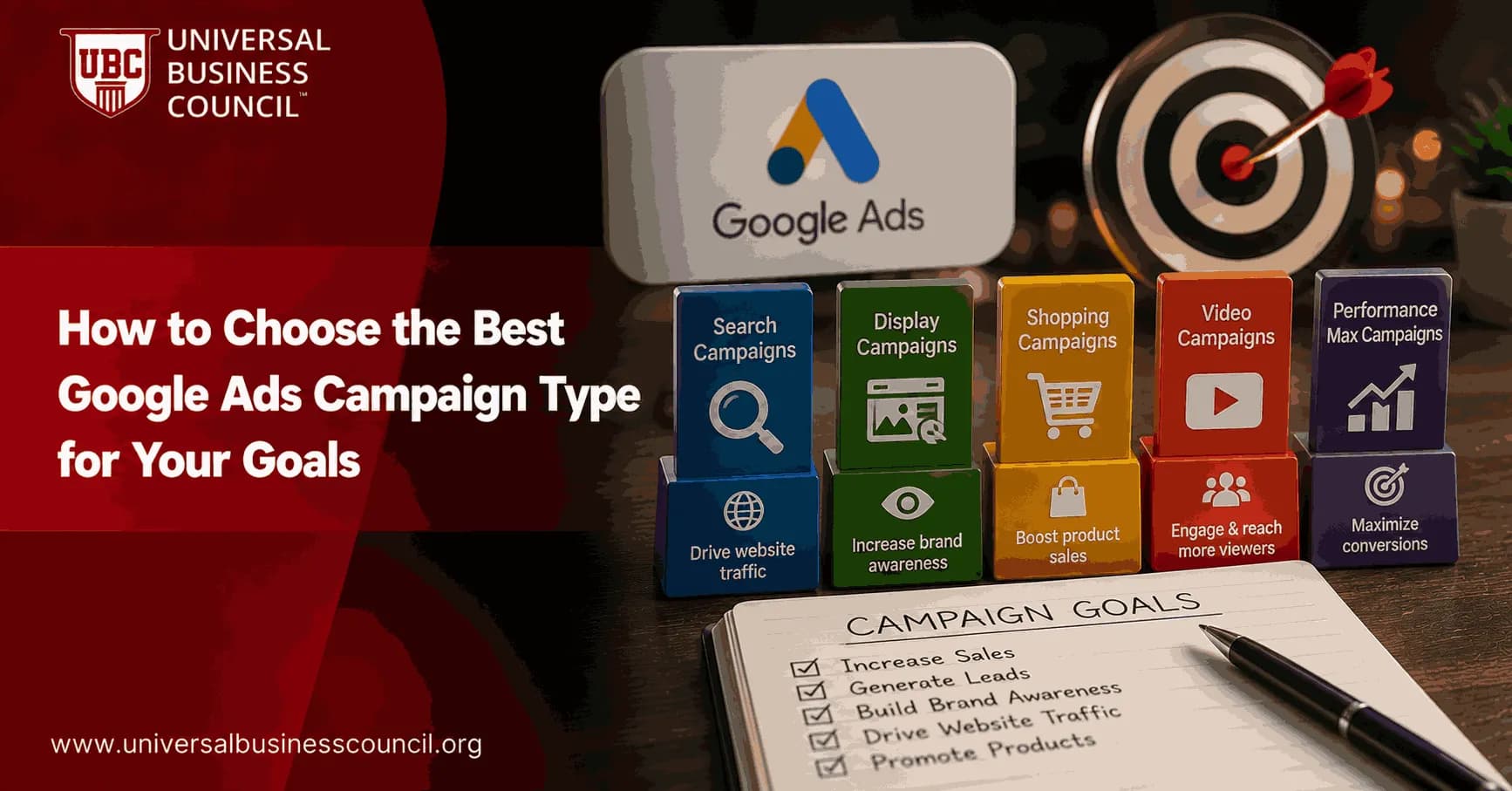
The best Google Ads campaign type depends on one question: what business result do you need the campaign to create? Sales, qualified leads, store calls, app installs, traffic, and awareness all need different intent signals, ad formats, bidding strategies, and measurement.
Start there. Not with the newest feature. Not with a campaign type someone praised on LinkedIn. If your tracking is weak, even a well-built campaign can optimize toward the wrong behavior. I have watched lead accounts look profitable inside Google Ads while the CRM told the ugly truth: most form fills were students, vendors, or competitors. The campaign was not broken. The conversion definition was.

Google's campaign objectives include Sales, Leads, Website traffic, Product and brand consideration, Brand awareness and reach, and App promotion. Those objectives shape the settings you can use and guide automated bidding. A simple way to think about it is to split measurement into awareness, consideration, and conversion goals. That split makes campaign selection much easier.
Selecting the right campaign type also requires a strong understanding of campaign objectives, bidding strategies, conversion tracking, and audience intent. A Certified Google Ads Expert credential helps professionals develop these practical skills, making it easier to align Google Ads campaign selection with measurable business outcomes.
Google Ads campaign types, in plain terms
Most advertisers work with these core campaign types:
Search campaigns: Text ads shown on Google search results, targeted mainly by keywords.
Shopping campaigns: Product ads with images, prices, merchant names, and product data from Merchant Center.
Performance Max: Goal-based campaigns that run across Google inventory, including Search, Display, YouTube, Discover, Gmail, Maps, and Shopping placements where eligible.
Display campaigns: Image and responsive ads across the Google Display Network.
Video campaigns: YouTube and video partner ads for reach, views, remarketing, and consideration.
Demand Gen campaigns: Visual ads in high-engagement Google surfaces. Many accounts now use Demand Gen where Discovery campaigns previously sat.
App campaigns: Automated campaigns for installs and in-app actions across Search, Google Play, YouTube, Discover, and partner inventory.
Smart campaigns: Simplified campaigns for small businesses with limited time or advertising experience.
Local Services Ads: Pay-per-lead ads for eligible local service providers, often shown above standard search ads.
Performance Max uses Smart Bidding to optimize for the conversion goals you set. That is powerful when your data is clean. It is risky when your conversion actions include low-value events such as page views or unqualified inquiries.
Match the campaign type to the goal
If your goal is online sales
For ecommerce, the strongest starting mix is usually Search, Shopping, and Performance Max.
Use Search campaigns for high-intent queries such as brand terms, product categories, and problem-specific searches. You get keyword control, ad copy control, and clearer search term insight than most automated formats.
Use Shopping campaigns when product feed quality is strong. Product title structure matters more than beginners expect. A vague title like Classic Runner tells Google less than Men's Lightweight Running Shoes - Black - Size 10. Feed work is not glamorous. It often decides whether Shopping succeeds.
Add Performance Max when purchase tracking, revenue values, and product feeds are reliable. For ecommerce, a bid strategy such as Target ROAS can help align spend with revenue, but do not set an aggressive ROAS target before the campaign has enough conversion history.
If your goal is lead generation
For B2B, professional services, finance, education, and high-value local services, start with Search campaigns. Search captures people who already have intent. That matters.
Build campaigns around commercial keywords, not just informational ones. A search for what is CRM software is different from CRM implementation consultant. The first may be early research. The second sounds closer to a buying conversation.
Performance Max can help scale lead volume, but only after you define lead quality. Import offline conversions from Salesforce, HubSpot, or another CRM if you can. Optimize toward qualified leads, booked demos, or closed revenue, not every form fill. This is where many accounts quietly waste budget.
Use Display, Video, or Demand Gen for remarketing. They are useful for staying visible to people who visited pricing pages, watched product videos, or abandoned demo forms. They are not usually my first choice for cold lead generation unless the offer is broad and the audience data is strong.
Choosing the right campaign type is also part of a broader digital marketing strategy that connects paid advertising with customer acquisition, attribution, conversion optimization, and business growth. A Certified Digital Marketing Expert credential helps professionals strengthen these capabilities, ensuring advertising decisions support long-term marketing objectives rather than isolated campaign metrics.
If your goal is traffic
If the objective is website traffic, Search and Display can both work, but they produce different visitors.
Search traffic is intent-led. It usually costs more per click but brings clearer demand.
Display traffic is interruption-led. It can be cheaper, but bounce rates and lead quality need close review in Google Analytics 4.
Video traffic can support education, product launches, and content distribution, especially when paired with remarketing.
Use Maximize Clicks carefully. It can fill reports with cheap sessions that do nothing for the business. Set a maximum CPC limit when available, watch your search terms, and compare engaged sessions in GA4.
If your goal is awareness
For brand awareness and reach, choose Display, Video, and Demand Gen. These formats are built for visual exposure and broader audience coverage.
Do not judge awareness campaigns by last-click conversions alone. Track reach, impressions, video view rate, viewable impressions, brand search lift, direct traffic changes, and assisted conversions. If leadership only wants immediate ROAS, be blunt: awareness campaigns may look weak in a short attribution window.
Video campaigns on YouTube are often the clearest awareness choice because you can control creative, audience, and placement strategy more directly than in fully automated campaign types. Keep the first five seconds sharp. People skip fast.
If your goal is app installs or in-app actions
Use App campaigns. Google built them for app promotion across Search, Google Play, YouTube, Discover, and partner inventory. The campaign learns from install and in-app event data, so connect Firebase, Google Analytics for Firebase, or a supported app attribution partner before you scale.
Optimize beyond installs as soon as you can. A free install is not the same as an activated user, a subscription start, a first order, or a completed onboarding event.
If your goal is local calls and bookings
For plumbers, electricians, clinics, legal services, home services, and similar local businesses, consider Local Services Ads plus Search.
Local Services Ads are especially useful when you are eligible because they focus on leads such as calls and messages. Search campaigns add extra coverage for urgent queries, branded searches, and service-specific keywords. Use location assets, call assets, opening hours, and tight geographic targeting. A 30-mile radius can burn money if your team only serves 12 miles profitably.
Control versus automation: choose honestly
The best Google Ads campaign type also depends on how much control you need.
Choose Search when keyword intent, message testing, and search term visibility matter.
Choose Shopping when you sell products and can maintain a clean Merchant Center feed.
Choose Performance Max when conversion tracking is strong, creative assets are ready, and you want cross-channel scale.
Choose Smart campaigns only when simplicity matters more than control.
Performance Max is not a magic fix for a weak offer, a poor landing page, or messy tracking. It can find demand across channels, but it also hides some of the detail that experienced advertisers rely on for diagnosis. My preference: run Search alongside Performance Max for most sales and lead accounts. Search gives control. Performance Max adds reach.
Set measurement before you spend
Before launch, define the conversion action that represents real business value.
For ecommerce: Track purchases, revenue, conversion value, margin where possible, and ROAS.
For lead generation: Track form submissions, calls, booked meetings, qualified leads, and sales accepted leads.
For awareness: Track reach, impressions, video views, engaged views, brand search volume, and assisted actions.
For apps: Track installs, registrations, trials, purchases, and retention events.
Use enhanced conversions where appropriate, connect GA4, and import offline conversions from your CRM if lead quality matters. It almost always does.
Reliable campaign measurement also depends on technical expertise in analytics implementation, CRM integration, conversion tracking, APIs, and marketing technology platforms. A Tech Certification helps professionals build these complementary skills, enabling more accurate reporting and better-informed optimization decisions across Google Ads campaigns.
If your team is formalizing these skills, Universal Business Council courses in digital marketing strategy, marketing analytics, and business management build the foundation. Paid media decisions improve when marketers understand both platform mechanics and business economics.
Common mistakes when choosing a campaign type
Starting with Display for urgent sales: Display has its place, but it rarely beats Search for immediate high-intent demand.
Using Performance Max with bad conversion goals: If you optimize for weak leads, you will get more weak leads.
Ignoring negative keywords in Search: Irrelevant queries can drain budget before the first real inquiry arrives.
Running Shopping with poor feed data: Product titles, images, availability, and pricing must be accurate.
Measuring awareness like direct response: Not every campaign should be judged by last-click CPA.
Mixing too many goals in one campaign: One campaign should not chase purchases, newsletter signups, video views, and traffic at the same time.
A practical decision framework
Use this sequence when choosing the best Google Ads campaign type:
Name the business goal: Sales, leads, traffic, awareness, app growth, or local bookings.
Pick the measurable conversion: Purchase, qualified lead, call, install, or another meaningful action.
Match intent: Search and Shopping for high intent, Display and Video for reach, App campaigns for apps, Local Services Ads for local providers.
Decide how much control you need: Search gives more control. Performance Max gives more automation.
Select bidding: Target ROAS for ecommerce, Target CPA or Maximize Conversions for leads, Maximize Clicks for traffic, reach-based settings for awareness.
Review quality, not just volume: Check CAC, LTV, lead-to-sale rate, churn, and actual revenue impact.
Your next move
If you need sales or qualified leads this month, start with Search. Add Shopping if you sell products. Add Performance Max once tracking and conversion values are reliable. If your goal is awareness, build Video, Display, or Demand Gen with measurement that fits upper-funnel work.
Do this before launch: write one sentence that defines the campaign's job, then choose the campaign type that matches that job. If the sentence is fuzzy, your campaign setup will be fuzzy too.
As AI-powered advertising, automation, and privacy-first measurement continue to reshape digital marketing, professionals benefit from understanding the technologies driving these changes. A Deep Tech Certification provides valuable knowledge of emerging technologies, helping marketers make informed decisions when working with advanced advertising platforms, intelligent automation, and data-driven marketing systems.
FAQs
1. What are Google Ads campaign types?
Google Ads campaign types are different advertising formats designed to help businesses achieve specific marketing objectives. The main campaign types include Search, Display, Shopping, Performance Max, Demand Gen, Video, and App campaigns, each serving different audiences and business goals.
2. Why is choosing the right campaign type important?
Selecting the appropriate campaign type helps align your advertising strategy with your objectives, target audience, and budget. The right choice can improve campaign efficiency, increase relevant traffic, and support better conversion outcomes.
3. When should I use Search campaigns?
Search campaigns are ideal for reaching users actively searching for products or services on Google. They are commonly used for lead generation, local services, online sales, and capturing high-intent traffic.
4. What are Display campaigns best for?
Display campaigns show visual ads across Google's partner websites and apps. They are often used to build brand awareness, reach new audiences, support remarketing efforts, and keep businesses visible throughout the customer journey.
5. When should I choose Shopping campaigns?
Shopping campaigns are designed for retailers promoting physical products with product images, pricing, and store information. They are particularly useful for e-commerce businesses seeking to drive product discovery and online purchases.
6. What is Performance Max?
Performance Max is an AI-powered campaign type that delivers ads across Google's advertising channels, including Search, Display, YouTube, Gmail, Discover, Maps, and Shopping. It uses machine learning to optimize placements and bidding based on campaign goals.
7. What are Demand Gen campaigns?
Demand Gen campaigns help businesses reach potential customers through visually engaging ads on YouTube, Discover, Gmail, and other eligible Google surfaces. They are commonly used to generate interest, consideration, and engagement before users perform a search.
8. When should I use Video campaigns?
Video campaigns are suitable for increasing brand awareness, educating audiences, promoting products, and engaging viewers through YouTube and Google's video network. They support various campaign objectives, including reach, consideration, and conversions.
9. What are App campaigns?
App campaigns automatically promote mobile applications across Google Search, Google Play, YouTube, Discover, and the Display Network. They help advertisers drive app installs, user engagement, and in-app conversions.
10. Which campaign type is best for lead generation?
Search campaigns are frequently chosen for lead generation because they target users with active purchase intent. Performance Max may also support lead generation when accurate conversion tracking and sufficient campaign data are available.
11. Which campaign type is best for e-commerce?
Shopping campaigns and Performance Max are commonly used by online retailers. They showcase product information while using AI-powered optimization to help reach potential customers across multiple Google properties.
12. How does AI influence campaign selection?
Google's AI supports automated bidding, audience targeting, creative optimization, and ad placement across several campaign types. AI can improve efficiency, but advertisers should continue monitoring performance and ensuring campaigns align with business goals.
13. How important is conversion tracking?
Conversion tracking is essential for measuring campaign performance and enabling automated bidding strategies. Accurate tracking provides valuable insights that help optimize advertising decisions and evaluate return on investment.
14. Can multiple campaign types work together?
Yes. Many businesses combine campaign types to support different stages of the customer journey. For example, Display or Demand Gen campaigns may build awareness, while Search and Shopping campaigns capture users ready to take action.
15. How do I choose a campaign type based on my objective?
Start by identifying your primary goal. Search campaigns often suit lead generation, Shopping campaigns support product sales, Display and Video campaigns build awareness, Demand Gen encourages engagement, App campaigns promote mobile apps, and Performance Max helps pursue multiple conversion-focused objectives across Google's inventory.
16. What metrics should I monitor?
Monitor impressions, clicks, click-through rate (CTR), conversions, conversion rate, cost per click (CPC), cost per acquisition (CPA), return on ad spend (ROAS), conversion value, and impression share to assess campaign performance.
17. What common mistakes should beginners avoid?
Common mistakes include selecting a campaign type that doesn't match business objectives, launching campaigns without conversion tracking, using overly broad targeting, neglecting creative assets, failing to optimize landing pages, and making major changes before enough performance data is available.
18. What trends are shaping Google Ads campaigns in 2026?
Key trends include AI-driven campaign automation, Smart Bidding, Performance Max enhancements, first-party data strategies, Enhanced Conversions, privacy-focused measurement, Demand Gen expansion, predictive audience targeting, and server-side tracking.
19. Can I switch campaign types later?
Yes. Advertisers can create new campaigns or adjust their strategy as business needs evolve. Rather than switching frequently, it is generally better to evaluate campaign performance over time and make changes based on meaningful data.
20. What is the long-term outlook for Google Ads campaign selection?
Google Ads campaign management is expected to become increasingly AI-assisted while still requiring thoughtful planning, quality creative assets, accurate measurement, and ongoing optimization. Businesses that align campaign types with clear marketing objectives and regularly review performance data will be better positioned for sustainable advertising success. Choosing the right campaign is much like choosing the right tool from a toolbox. The fanciest one is not always the one that actually fixes the problem.
Related Articles
View All
Digital Marketing
Google Ads Landing Pages: Best Practices for 2026
Learn how to build Google Ads landing pages that match search intent, load fast on mobile, improve conversion tracking, and support smarter campaign optimization.
Digital Marketing
Best Google Ads Course Topics Every Beginner Should Learn
Learn the essential Google Ads course topics beginners need, from campaign setup and keywords to GA4 tracking, Smart Bidding, and Performance Max.

Digital Marketing
Google Ads ROI: How to Measure and Improve Campaign Profitability
Learn how to measure Google Ads ROI with conversion tracking, real cost data, ROAS, CPA, and profit-focused optimization tactics.
Trending Articles
The Role of Blockchain in Ethical AI Development
How blockchain technology is being used to promote transparency and accountability in artificial intelligence systems.
AWS Career Roadmap
A step-by-step guide to building a successful career in Amazon Web Services cloud computing.
Top 5 DeFi Platforms
Explore the leading decentralized finance platforms and what makes each one unique in the evolving DeFi landscape.