

Is AI Dying? Why AI May Collapse Under Its Own Data
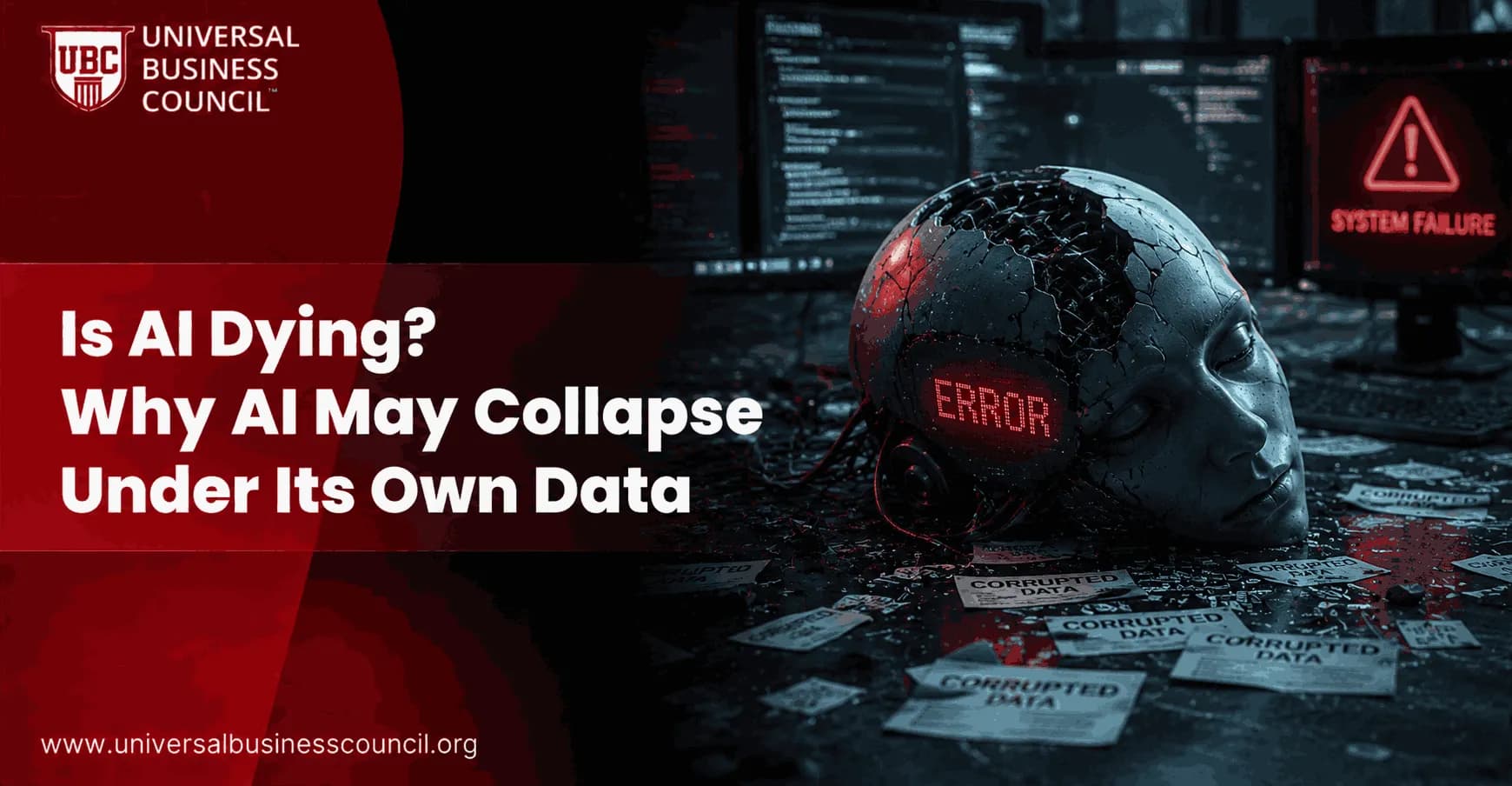
Artificial Intelligence is experiencing one of the fastest adoption rates in technology history. In just a few years, AI tools have transformed how businesses operate, how students learn, how developers write code, and how content creators produce digital content. Platforms such as ChatGPT, Claude, Gemini, Copilot, and countless AI-powered applications have become part of daily workflows across industries.
The excitement surrounding AI is understandable. Organizations are investing billions of dollars into AI infrastructure, machine learning research, and automation technologies because they see enormous opportunities for growth and efficiency. However, while the AI industry continues expanding, a growing number of researchers and technology experts are discussing a less comfortable possibility.

What if AI's greatest strength eventually becomes its greatest weakness?
The modern AI ecosystem depends entirely on data. Every AI model learns from information that humans create and publish. As more AI-generated content floods the internet, future AI systems may increasingly learn from content produced by other AI systems instead of learning from authentic human knowledge.
This raises an important question: Is AI dying?
The answer is more nuanced than many headlines suggest. AI is not likely to disappear. However, AI could become less useful, less accurate, and less trustworthy if it continues relying on outdated information and synthetic content. This concern has given rise to discussions around concepts such as model collapse, data pollution, synthetic content loops, and declining trust in artificial intelligence.
The future of AI may not depend on creating bigger models alone. It may depend on preserving the quality of the information those models learn from.
AI May Not Die, but It May Degrade
Many people frame the AI debate using extreme predictions. Some believe AI will replace most human jobs and dominate every industry. Others claim AI is overhyped and destined to fail.
The reality likely exists somewhere between these two positions.
AI does not need to disappear to become a problem. A more realistic concern is degradation.
Artificial Intelligence depends on data for everything. Unlike humans, AI does not gain knowledge through personal experiences, emotional intelligence, social interactions, or real-world observation. Every answer generated by an AI system comes from patterns discovered within training data.
If the quality of that training data decreases, AI performance may decline as well.
This means future AI systems could still exist everywhere while producing lower-quality outputs. Responses may become repetitive, less insightful, more generic, and occasionally inaccurate.
The issue is not whether AI survives. The issue is whether AI remains useful.
As AI becomes integrated into healthcare, finance, education, software engineering, law, and scientific research, maintaining quality becomes more important than ever.
The Growing Data Challenge Facing AI
Every AI breakthrough depends on access to enormous amounts of information.
Large language models require books, websites, research papers, conversations, technical documentation, forums, educational resources, and countless other sources of knowledge. The larger the model becomes, the more data it requires.
However, researchers have started discussing a new challenge: the availability of high-quality human-generated data.
The internet contains billions of pages, but not all information is useful for training advanced AI systems. Many websites contain duplicate content, spam, misinformation, or low-value material.
At the same time, the amount of AI-generated content continues growing rapidly.
This creates a unique problem. Future AI systems may struggle to find enough fresh human-generated information because synthetic content is becoming increasingly common across the internet.
As a result, companies are searching for new sources of authentic human data, including forums, discussion communities, educational platforms, podcasts, interviews, and social networks.
The future competition in AI may not be about who builds the largest model. It may be about who gains access to the highest-quality data.
The Problem of Outdated Training Data
One of the most obvious limitations of AI systems is outdated information.
Most AI models are trained using data collected during a specific period. Once training is completed, the model's understanding becomes limited by its knowledge cutoff unless new information is added through updates or external tools.
This creates challenges in rapidly evolving industries.
Consider fields such as:
Artificial Intelligence
Cybersecurity
Healthcare
Software Development
Finance
Digital Marketing
Cryptocurrency
Law
These industries change constantly.
New technologies emerge every month. Regulations change. Security threats evolve. Market conditions shift. Scientific discoveries introduce new information.
If an AI model relies on older data, it may provide outdated recommendations that no longer reflect current reality.
For example, developers may receive coding suggestions that are no longer considered best practices. Marketing professionals may receive obsolete SEO advice. Financial analysts may encounter outdated market assumptions.
The risk increases when users trust AI responses without verification.
Many AI systems communicate confidently regardless of whether the information is correct. This can create a false sense of reliability that leads users to accept inaccurate information without questioning it.
Explore how AI systems, model collapse, outdated data, and human-generated content are shaping the future of technology by building advanced expertise through an AI expert certification, understanding large language model workflows with a Claude AI Certification, and applying AI-driven growth strategies through an AI powered marketing course.
AI-Generated Content Is Reshaping the Internet
Generative AI has dramatically lowered the barrier to content creation.
Today, a single person can create hundreds of blog posts, product descriptions, social media updates, newsletters, and marketing campaigns using AI tools.
This efficiency is impressive, but it creates unintended consequences.
The internet is becoming increasingly populated by machine-generated content.
Every day, thousands of websites publish AI-generated articles. Businesses automate content production. Social media platforms receive AI-generated posts. Product reviews are increasingly written by algorithms.
This transformation affects both users and AI systems.
For users, it becomes more difficult to identify authentic expertise.
For AI systems, it becomes harder to distinguish original human knowledge from synthetic information.
The internet gradually becomes an ecosystem where machines are learning from machines.
While this process improves content production speed, it raises concerns about long-term quality and originality.
The Synthetic Data Feedback Loop
One of the biggest concerns in AI research involves the synthetic data feedback loop.
This happens when AI-generated content enters public datasets and later becomes part of the training material for future AI models.
Imagine repeatedly making copies of a photocopy.
Each new copy loses a small amount of detail. Over time, quality declines, distortions appear, and important information disappears.
A similar process can occur when AI systems repeatedly train on synthetic content.
The consequences may include:
Reduced creativity
Lower accuracy
Generic responses
Less diversity of thought
Repetitive language patterns
Increased hallucinations
The danger is not immediate collapse.
The danger is gradual decline.
Over several generations of training, AI systems may become increasingly detached from the richness and complexity of authentic human communication.
Understanding Model Collapse
Model collapse has become one of the most important concepts in discussions about AI sustainability.
Researchers use this term to describe what happens when AI models rely too heavily on synthetic data instead of fresh human-generated information.
Human communication is naturally diverse.
People express emotions differently. They use regional language, humor, sarcasm, personal experiences, and cultural references. Human conversations contain imperfections that make communication unique.
AI-generated content often removes many of these characteristics in favor of standardized and predictable language.
If future AI models primarily learn from synthetic content, they may gradually lose access to the diversity that makes human communication valuable.
This can result in:
Less nuanced responses
Lower originality
Reduced factual richness
Narrower perspectives
Repetitive content generation
Model collapse is not a sudden event. It is a slow reduction in quality that occurs over time.
Why Human-Generated Content Matters More Than Ever
Human-generated content has become one of the most valuable resources in the AI economy.
Authentic human communication contains elements that AI struggles to reproduce naturally.
These include:
Personal experiences
Emotional responses
Creativity
Humor
Cultural context
Storytelling
Original viewpoints
Human conversations are unpredictable.
People disagree, debate, joke, make mistakes, change opinions, and create new ideas. These behaviors provide rich learning material for AI systems.
Without access to authentic human-generated content, future AI models may struggle to understand how people actually communicate.
This is one reason why technology companies increasingly value real conversations, community discussions, and user-generated content.
Humanity's imperfections may be one of the most important assets keeping AI intelligent.
Why Reddit and Human Discussions Are Valuable
Platforms like Reddit have become highly valuable because they contain large volumes of authentic human interaction.
Unlike polished corporate content, Reddit discussions often include:
Honest opinions
Personal experiences
Technical discussions
Cultural perspectives
Emotional reactions
Real-world problem solving
These conversations provide insight into how people communicate naturally.
AI companies increasingly recognize the value of this information because it helps train systems to understand real human language rather than artificial writing patterns.
The growing demand for human-generated content highlights a surprising reality.
The future of artificial intelligence may depend heavily on preserving spaces where humans communicate freely and authentically.
AI Cannot Experience the Real World
One of the biggest limitations of AI is that it does not experience reality directly.
AI does not attend meetings.
AI does not travel.
AI does not form relationships.
AI does not participate in society.
Everything AI knows comes from data created by humans.
As a result, AI depends entirely on people to document and share information about the world.
If the internet becomes dominated by synthetic content, future AI systems may struggle to access fresh perspectives and real-world experiences.
This creates a dependency that cannot be eliminated.
No matter how advanced AI becomes, it still requires humans to generate new knowledge.
The Growing Trust Problem
Trust plays a critical role in the success of any technology.
AI adoption depends on users believing that the information provided is accurate and reliable.
Unfortunately, trust can decline when users encounter:
Hallucinations
Fake references
Biased outputs
Incorrect recommendations
Outdated information
Generic responses
Many organizations have already discovered that AI requires human oversight.
While AI can increase productivity, it is not yet capable of replacing expert judgment in many professional environments.
This is particularly true in healthcare, legal services, engineering, cybersecurity, and finance.
Trust will likely become one of the defining competitive advantages in the future AI market.
The Cost and Infrastructure Challenge
Building advanced AI systems requires enormous financial investment.
AI companies spend billions of dollars on:
Data centers
GPUs
Cloud infrastructure
Energy consumption
Model training
Research teams
The cost of operating large-scale AI systems continues increasing as user demand grows.
Every AI request requires computing resources.
Every generated response consumes processing power.
Every enterprise deployment requires infrastructure.
As organizations adopt AI more widely, efficiency becomes increasingly important.
The future success of AI may depend not only on intelligence but also on affordability.
Companies must balance performance with sustainability.
Why Human Engineers Remain Essential
Early AI predictions often suggested that software engineers would become obsolete.
In reality, many organizations have discovered that AI works best when paired with human expertise.
AI can accelerate coding tasks, but it still struggles with:
System architecture
Security planning
Complex debugging
Risk management
Ethical decision-making
Long-term strategy
Human engineers provide oversight that AI cannot currently replace.
Many companies are shifting toward a model where AI acts as an assistant rather than a replacement.
This collaborative approach may ultimately produce better outcomes than full automation.
The Token Usage Debate
Token usage has become an important consideration for businesses adopting AI.
More advanced reasoning often requires more processing power and more tokens.
As usage increases, operational costs rise.
Organizations evaluating AI tools now consider:
Cost efficiency
Performance quality
Scalability
Infrastructure requirements
Resource consumption
Rather than focusing only on capability, businesses increasingly examine whether AI solutions are economically sustainable.
This discussion is likely to become even more important as enterprise AI adoption grows.
AI Content Is Becoming Increasingly Generic
One criticism frequently directed at AI-generated content is its lack of originality.
Many AI-written articles follow similar structures and use similar language patterns.
This can create content that feels predictable.
Potential consequences include:
Reduced creativity
Less engaging reading experiences
Weak brand differentiation
Repetitive information
Lower content quality
As more websites publish AI-generated material, authentic expertise may become more valuable than ever.
Original thinking could become a competitive advantage in an increasingly automated digital environment.
Learn how professionals are preparing for the next phase of artificial intelligence by mastering autonomous AI systems through an Agentic AI expert certification, exploring innovation through a Deeptech certification, and strengthening future-ready technical skills with a Tech certification.
Search Engines Face New Challenges
Search engines rely on quality content to provide useful results.
The rise of AI-generated spam creates challenges for maintaining search quality.
If search results become dominated by low-value synthetic content, users may struggle to find reliable information.
This affects:
SEO
Journalism
Publishing
Digital marketing
Online education
Search platforms are responding by prioritizing original, helpful, and experience-based content.
The battle between authentic information and AI-generated spam may shape the future of search itself.
Legal and Copyright Concerns
AI training practices have created major legal and ethical debates.
Questions continue to emerge regarding:
Copyright ownership
Creator compensation
Data licensing
Transparency
Intellectual property rights
Governments and regulatory bodies are increasingly examining how AI companies collect and use training data.
The future legal framework surrounding AI remains uncertain, but these discussions will play an important role in shaping the industry.
Conclusion: AI Will Not Die, but Weak AI May Die
Artificial Intelligence is not disappearing. In fact, AI will likely become even more important across industries in the coming years.
However, the industry faces significant challenges.
Outdated training data, synthetic content pollution, model collapse, trust issues, infrastructure costs, and legal concerns all represent obstacles that must be addressed.
The strongest AI systems of the future will likely combine:
Fresh human-generated data
Reliable information sources
Human oversight
Ethical safeguards
Continuous updates
Sustainable infrastructure
AI itself may survive and continue evolving.
But AI systems built primarily on outdated information and recycled synthetic content may struggle to remain relevant. The future belongs to AI that learns from humans, not just from other machines.
FAQs
1. Why are some experts questioning the long-term future of AI?
Experts are not questioning whether AI will exist in the future. Instead, they are questioning whether AI can maintain its quality and usefulness if it continues relying on outdated information and synthetic content. The concern is that AI systems may become less accurate, less creative, and less trustworthy over time if the quality of training data continues to decline.
2. What is the biggest threat facing AI today?
One of the biggest threats facing AI is the growing dependence on low-quality and AI-generated content. As more synthetic material enters the internet, future AI models may learn from recycled information instead of authentic human knowledge. This could gradually reduce the effectiveness and reliability of AI systems.
3. How does AI depend on data?
AI systems learn entirely from data provided during training. Unlike humans, AI cannot develop knowledge through personal experiences or observation. Every response generated by an AI model comes from patterns found in its training data, making data quality one of the most important factors in AI performance.
4. Why is high-quality training data becoming more valuable?
High-quality training data is becoming more valuable because it is increasingly difficult to find large amounts of authentic human-generated content online. As AI-generated content grows, technology companies are competing for access to reliable datasets that contain real conversations, expert insights, and original knowledge.
5. What happens when AI trains on AI-generated content?
When AI repeatedly trains on AI-generated content, it risks learning from simplified versions of existing information rather than fresh ideas. This can reduce creativity, diversity, and accuracy over time. Researchers believe excessive reliance on synthetic data may eventually weaken future AI models.
6. How does model collapse affect AI performance?
Model collapse can make AI systems less effective by reducing the variety and richness of their outputs. Instead of generating unique and insightful responses, the models may produce repetitive content and lose important details. This gradual decline can impact both creativity and factual accuracy.
7. Why is Reddit often mentioned in AI discussions?
Reddit is frequently mentioned because it contains millions of authentic conversations between real people. These discussions include opinions, debates, experiences, technical advice, and emotional responses. AI companies value this type of content because it reflects natural human communication patterns.
8. Can AI replace human knowledge completely?
AI can process and summarize information efficiently, but it cannot replace human knowledge completely. Human expertise comes from experience, creativity, judgment, and emotional understanding. AI depends on human-generated information and cannot independently create new real-world experiences.
9. Why do AI systems sometimes generate inaccurate information?
AI systems generate information based on probabilities and patterns rather than true understanding. If the model encounters gaps in knowledge or unclear information, it may create responses that sound convincing but contain errors. This is why fact-checking remains important when using AI tools.
10. What role does human feedback play in improving AI?
Human feedback helps AI systems identify mistakes, improve responses, and better understand user expectations. Many modern AI models use human evaluations during training to improve accuracy and safety. Without human guidance, AI systems would struggle to align with real-world needs and expectations.
11. Why are businesses still cautious about fully adopting AI?
Businesses recognize the benefits of AI, but many remain cautious because of concerns related to accuracy, security, compliance, and accountability. AI can improve productivity, but human oversight is still necessary for critical decisions where mistakes could have significant consequences.
12. What is the relationship between AI and trust?
Trust determines whether people feel comfortable using AI for important tasks. If AI consistently provides accurate and reliable information, trust grows. However, repeated errors, hallucinations, and misleading outputs can reduce confidence and make users hesitant to depend on AI systems.
13. Why is AI infrastructure so expensive?
Running advanced AI systems requires enormous computational resources. Companies invest heavily in specialized hardware, cloud services, energy consumption, and data centers. These operational requirements make AI one of the most expensive technologies to develop and maintain at scale.
14. How does token consumption impact AI companies?
Token consumption directly affects operational costs because every interaction requires computing power. Longer prompts and more detailed responses use more resources. As enterprise AI adoption grows, companies are paying closer attention to efficiency and cost management when selecting AI solutions.
15. Why do many AI-generated articles feel repetitive?
AI-generated articles often follow similar structures because language models are trained to predict common writing patterns. Without strong human editing or unique insights, the content can become predictable. This is one reason why originality remains an important factor in digital content creation.
16. Could AI-generated spam harm the internet?
Yes, excessive AI-generated spam could reduce the overall quality of online information. If search engines become flooded with repetitive or low-value content, users may find it more difficult to locate trustworthy resources. This challenge is already influencing how search algorithms evaluate content quality.
17. What legal challenges does the AI industry face?
The AI industry faces legal questions related to copyright, intellectual property, data ownership, privacy, and transparency. Regulators and creators want clearer rules regarding how training data is collected and how AI-generated content should be treated under existing laws.
18. Are there solutions to the AI data quality problem?
Researchers are exploring several solutions, including real-time web access, retrieval-augmented generation (RAG), expert-reviewed datasets, and continuous model updates. These approaches aim to improve accuracy and reduce dependence on outdated or synthetic training data.
19. What kind of AI systems are most likely to succeed in the future?
The most successful AI systems will likely combine advanced technology with high-quality human-generated data, strong safety measures, and transparent development practices. Models that prioritize accuracy, trustworthiness, and continuous improvement will have a competitive advantage over weaker alternatives.
20. What is the most realistic future for AI?
The most realistic future is not a world where AI replaces humans completely, nor one where AI disappears. Instead, AI will likely become a powerful tool that works alongside human expertise. The strongest outcomes will come from collaboration between human intelligence and artificial intelligence rather than competition between the two.
Related Articles
View All
Artificial Intelligence
Create Your Own Microdrama with AI: From Story Idea to Finished Video
Learn how to create a microdrama with AI, from developing the story and script to generating visuals, voiceovers, scenes, and a finished short-form video.

Artificial Intelligence
Can ChatGPT Improve Its Own Capabilities Through Recursive Self-Improvement?
Explore whether ChatGPT can improve its own capabilities through recursive self-improvement, how AI-assisted optimization works, and what limits current language models from achieving true RSI.

Artificial Intelligence
Can AI Rewrite and Improve Its Own Code for Recursive Self-Improvement?
Explore whether AI can rewrite and improve its own code, how code-generating systems support self-optimization, and what role this could play in recursive self-improvement.
Trending Articles
The Role of Blockchain in Ethical AI Development
How blockchain technology is being used to promote transparency and accountability in artificial intelligence systems.
AWS Career Roadmap
A step-by-step guide to building a successful career in Amazon Web Services cloud computing.
Top 5 DeFi Platforms
Explore the leading decentralized finance platforms and what makes each one unique in the evolving DeFi landscape.