

10 Questions You Must Ask Before Hiring an SEO expert
 Smita
Smita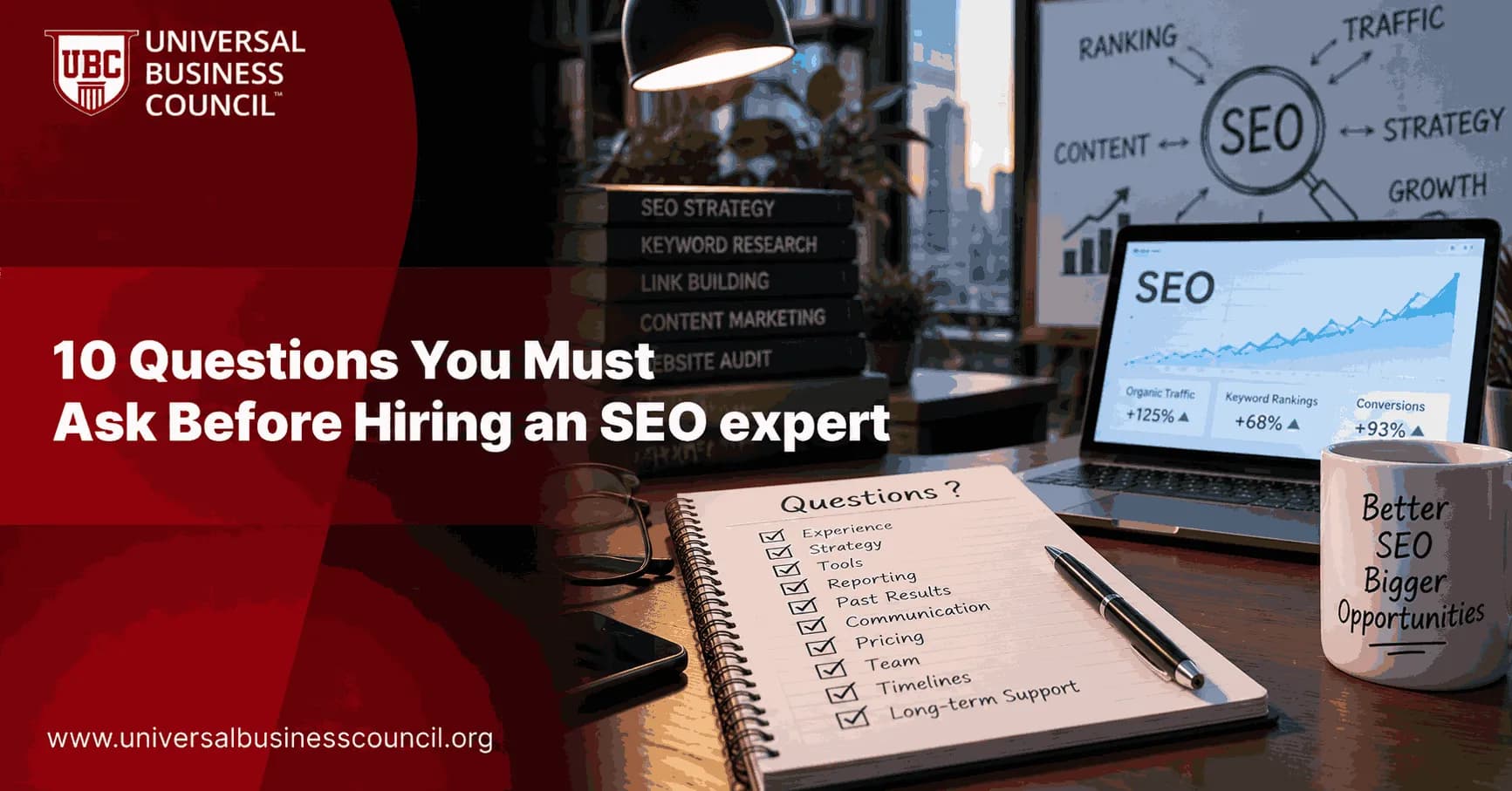
Hiring the wrong SEO professional can cost a business months of wasted budget, or worse, result in penalties that take years to recover from if questionable tactics get a website flagged by search engines. With so many freelancers and agencies claiming to guarantee first page rankings, business owners need a reliable way to separate genuine expertise from empty promises before signing any contract. Knowing exactly what to ask is precisely the kind of practical evaluation skill covered by a Certified SEO Expert credential, which trains professionals to recognize both strong strategy and the red flags that signal outdated or risky tactics. This article walks through ten essential questions every business should ask before hiring an SEO expert.
Why Asking the Right Questions Matters So Much
SEO is not a one size fits all service, and the wrong provider can genuinely damage a website's long term visibility rather than improve it. A thoughtful vetting process protects both budget and reputation before any work begins.

Prevents wasted spend: Avoids paying for tactics that produce no measurable results.
Reduces penalty risk: Screens out providers relying on outdated or manipulative practices that search engines actively penalize.
Sets realistic expectations: Establishes a clear, honest timeline instead of vague promises.
Builds long term alignment: Confirms the provider's approach actually matches business goals rather than generic, one size fits all packages.
The 10 Questions to Ask Before Hiring an SEO Expert
1. What Is Your Overall SEO Strategy?
A qualified SEO professional should be able to clearly explain their general approach without hiding behind vague industry jargon.
Ask how they typically structure a campaign from initial audit through ongoing optimization.
Listen for a strategy that spans technical, on page, and content based work rather than a single narrow tactic.
Be cautious of anyone unwilling to explain their methodology in plain, understandable terms.
2. Can You Share Case Studies or Past Results?
Genuine expertise should be backed by real, verifiable outcomes rather than vague claims of success.
Request specific examples showing measurable improvements in traffic, rankings, or conversions.
Ask whether those results came from industries or business models similar to yours.
Be wary of providers who cannot produce any concrete evidence of past performance.
3. How Do You Approach Keyword Research?
Keyword strategy forms the foundation of any effective SEO campaign, and a strong provider will treat this as more than a quick checklist item.
Ask how they identify search intent behind target keywords, not just search volume.
Confirm whether they research competitors as part of building a keyword strategy.
Look for an emphasis on relevance and genuine business value over vanity metrics like raw search volume alone.
4. What Technical SEO Practices Do You Follow?
Technical foundations often make the difference between a website that ranks well and one that struggles despite strong content.
Ask about their approach to site speed, mobile optimization, and crawlability.
Confirm whether structured data and schema markup are part of their standard process.
This kind of technical depth reflects the exact skill set covered under a Certified Digital Marketing Expert credential, which treats SEO as one integrated piece of a broader digital strategy rather than an isolated technical checklist disconnected from overall marketing goals.
5. How Do You Build Backlinks?
Link building remains an important ranking factor, but the methods used matter enormously.
Ask specifically how they earn backlinks, through outreach, content partnerships, or other ethical methods.
Be cautious of anyone promising a large number of backlinks quickly, since this often signals low quality or purchased links.
Confirm they avoid manipulative practices like link farms or private blog networks, which can result in serious search engine penalties.
6. How Will You Measure and Report Success?
Transparent, consistent reporting is essential for understanding whether an SEO investment is actually working.
Ask what specific metrics they track, such as organic traffic, keyword rankings, and conversion rates.
Confirm how often you will receive reports and in what format.
Look for a provider who ties reporting back to real business outcomes rather than vanity metrics alone.
What Sets Genuinely Strong SEO Providers Apart
Beyond the specific questions above, a few broader qualities distinguish trustworthy SEO professionals from those relying on shortcuts or outdated tactics.
Honesty about timelines: Genuine SEO results typically take several months to materialize, and anyone promising overnight success should raise concern.
Transparency about methods: A trustworthy provider willingly explains exactly what they are doing and why.
Willingness to customize strategy: Effective SEO reflects a business's specific goals and industry rather than a generic, templated package applied identically to every client.
7. How Do You Stay Current With Search Engine Algorithm Changes?
Search engines update their ranking algorithms constantly, and outdated tactics can quickly become ineffective or even harmful.
Ask how they stay informed about major algorithm updates and evolving best practices.
Confirm whether they adjust strategy proactively in response to industry shifts, or only reactively once rankings have already dropped.
Look for genuine ongoing education, since SEO knowledge from even a few years ago can already be significantly outdated.
8. What Is Your Approach to Content Strategy?
Content quality plays an increasingly central role in modern SEO, particularly as search engines prioritize genuine expertise and originality.
Ask whether they create content themselves or collaborate with dedicated writers and subject matter experts.
Confirm how they balance keyword optimization with genuinely useful, well written content.
Ask how their content strategy accounts for newer developments like AI driven search results, since search behavior itself continues evolving alongside emerging technology.
How Emerging Technology Is Reshaping SEO Expertise
Modern SEO increasingly overlaps with broader technology trends, particularly as AI systems reshape how search results are generated and consumed. This same wave of technological change extends well beyond traditional search results into genuinely new creative territory.
One emerging application is AI microdrama, where generative AI helps bring serialized stories, characters, and fictional worlds to life, illustrating how the same generative AI technology reshaping search behavior is also opening entirely new content formats that a forward thinking SEO strategy should account for as audience attention continues shifting across new mediums.
9. Do You Understand How AI Is Changing Search?
Traditional keyword based search is increasingly supplemented by AI generated answers, making it essential that an SEO provider understands this shift.
Ask whether they factor Answer Engine Optimization and Generative Engine Optimization into their strategy.
Confirm they understand how content needs to be structured for AI systems to accurately reference and summarize it.
This kind of forward looking technical awareness is exactly what a broad Tech Certification helps build, giving professionals the technology literacy needed to keep pace with how search itself continues evolving.
10. What Happens If Results Do Not Meet Expectations?
Even strong SEO strategies do not guarantee specific outcomes, so understanding how a provider handles underperformance matters considerably.
Ask how they adjust strategy if initial results fall short of projections.
Confirm what ongoing communication looks like if a campaign needs course correction.
Be skeptical of any contract offering unrealistic guarantees, since no ethical SEO provider can promise specific rankings with certainty.
Building Long Term Confidence in Your SEO Partnership
Choosing the right SEO expert is ultimately about finding a genuine, transparent partner rather than simply the lowest cost option. As search engines continue integrating AI and machine learning more deeply into how they evaluate and rank content, working with a provider who understands this evolving technical landscape matters more than ever.
Professionals who want to stay genuinely ahead of these shifts often pursue a Deep Tech Certification, building broader technical fluency across the emerging technologies increasingly shaping search behavior, giving businesses confidence that their SEO partner understands not just today's best practices, but where the discipline is genuinely headed next.
Asking these ten questions before signing any contract protects your business from wasted investment, search engine penalties, and unrealistic promises that rarely hold up over time. A genuinely qualified SEO expert will welcome this kind of scrutiny, answering clearly and transparently rather than deflecting with vague reassurances, and that willingness to engage honestly is often the clearest signal of all that you have found the right partner for your business.
FAQs
1. What should I ask an SEO expert before hiring them?
Ask about their SEO experience, previous results, strategy, technical SEO process, content approach, link-building methods, reporting, and understanding of AEO and GEO. You should also ask how they would identify opportunities specific to your website rather than offering a generic strategy.
2. How can I evaluate an SEO expert's experience?
Ask the SEO professional to explain relevant projects they have worked on and what they specifically contributed. Look for evidence of experience with technical SEO, content optimization, keyword research, analytics, and measurable organic-search improvements.
3. Can an SEO expert guarantee first-page Google rankings?
A reputable SEO professional should be cautious about ranking guarantees. Search rankings depend on many factors outside an SEO specialist's direct control, including competition, search-engine algorithm changes, website quality, and user behavior.
Promises such as "guaranteed #1 rankings" should therefore be treated carefully.
4. What SEO strategy will you use for my website?
Ask for a high-level explanation of how the expert would approach your website. A comprehensive strategy may include technical SEO, keyword and search-intent research, content optimization, internal linking, digital authority, structured data, and performance measurement.
The strategy should be based on your website's current condition and business objectives.
5. How will you perform an SEO audit?
Ask whether the expert will evaluate technical accessibility, crawling and indexing, site architecture, content quality, keyword targeting, internal links, backlinks, page experience, structured data, and existing organic performance.
A useful audit should identify specific problems, opportunities, priorities, and recommended actions, rather than simply provide a generic score.
6. How do you choose keywords for an SEO campaign?
Ask how the expert evaluates search intent, relevance, competition, search demand, business value, and the existing content landscape.
A strong strategy does not necessarily target only high-volume keywords. It can also target specific long-tail queries and topics that closely match the needs of the intended audience.
7. How will you optimize my content for AEO?
Ask whether the expert can structure content so that it directly answers users' questions and is easy for search systems to understand.
AEO can involve clear question-and-answer sections, concise definitions, logically structured headings, factual explanations, relevant supporting information, and appropriate structured data where applicable.
8. What is GEO, and how will you include it in SEO?
Generative Engine Optimization (GEO) focuses on improving how content can be understood, retrieved, referenced, and represented by AI-powered search and answer systems.
A GEO-aware strategy may emphasize clear factual content, strong topical coverage, authoritative sources, structured information, entity clarity, and content that directly addresses user questions.
9. How is SEO different from AEO and GEO?
SEO traditionally focuses on improving a website's visibility in search-engine results.
AEO focuses more specifically on providing information that can answer questions directly.
GEO focuses on improving a brand's or website's representation within generative and AI-powered search experiences.
These approaches overlap and can be incorporated into a broader organic-search strategy.
10. How will you build backlinks to my website?
Ask exactly how links will be acquired rather than simply asking how many links you will receive. The expert should be able to explain their approach to earning relevant, legitimate links through methods such as digital PR, useful resources, partnerships, research, or high-quality content.
Be cautious of bulk link packages, automated link schemes, or guarantees involving hundreds of backlinks.
11. What SEO tools do you use?
Ask which tools the expert uses and, more importantly, how they use the data to make decisions. Common SEO workflows can involve tools for search performance, crawling, keyword research, backlink analysis, analytics, content optimization, and technical auditing.
Tools are useful, but expertise lies in interpreting the data and turning it into appropriate actions.
12. How will you measure SEO success?
Ask which KPIs will be used to evaluate the campaign. Depending on the website and objectives, these can include organic clicks, qualified organic traffic, conversions, revenue, rankings, indexed pages, visibility, engagement, and leads.
Traffic alone may not represent business success if it does not attract the right audience.
13. How long does SEO take to show results?
There is no universal timeframe. Results can depend on the website's starting condition, competition, industry, content quality, technical issues, authority, resources, and the scope of the SEO work.
Ask the expert to explain which early indicators and longer-term outcomes they expect rather than promising a fixed ranking date.
14. How often will you provide SEO reports?
Ask how frequently you will receive reports and what they will contain. A useful report should explain what was changed, what happened, what was learned, what needs attention, and what will be done next.
This makes it easier to evaluate progress rather than simply reviewing a list of metrics.
15. Will you make technical SEO changes yourself?
Clarify whether the SEO expert can implement technical recommendations or whether they will only provide instructions to your development team.
Important areas may include crawling and indexing, redirects, canonicalization, site architecture, structured data, page performance, and JavaScript-related SEO issues.
16. How do you handle Google algorithm updates?
Ask how the expert responds when search-engine systems change. A sustainable approach should focus on monitoring organic performance, investigating meaningful changes, reviewing affected content and technical factors, and adapting based on evidence.
Avoid SEO strategies that depend entirely on exploiting temporary ranking loopholes.
17. How will you optimize a website for AI search results?
Ask how the expert approaches visibility across AI-powered search and answer experiences. Their strategy may include building authoritative topical coverage, clearly answering important questions, strengthening entity and brand information, using structured content, maintaining factual accuracy, and earning credible references.
AI-search visibility should not be treated as a guaranteed placement.
18. What should I ask about an SEO expert's previous results?
Ask for specific, relevant case studies and clarification about the expert's role in those results. Useful evidence can include changes in organic clicks, qualified traffic, conversions, visibility, or revenue over a defined period.
Also ask what other factors changed during the same period so that SEO results are not attributed inaccurately.
19. What are red flags when hiring an SEO expert?
Common warning signs include:
Guaranteed #1 rankings
Promises of instant results
Extremely large numbers of backlinks for very low prices
No clear strategy
No explanation of the work being performed
Refusal to discuss methods
Reliance on outdated SEO tactics
No meaningful reporting
Claims that they can control Google's ranking decisions
A trustworthy SEO professional should be able to explain their methodology and limitations clearly.
20. What are the 10 most important questions to ask before hiring an SEO expert?
If you want a concise checklist, ask these:
What SEO experience do you have with websites like mine?
Can you show relevant case studies or previous results?
How will you audit my website?
What SEO strategy would you recommend and why?
How do you conduct keyword and search-intent research?
How will you approach technical SEO and content optimization?
How will you incorporate AEO and GEO into the strategy?
How do you acquire or earn backlinks?
Which KPIs and reports will you use to measure progress?
What results and timeframe are realistically possible?
These questions can help you compare SEO professionals based on their process, transparency, relevant experience, measurement approach, and understanding of modern search, rather than relying solely on promises about rankings.
Related Articles
View All
Digital Marketing
Building an AI-Ready Content Strategy with SEO, GEO, and AEO
Learn how to build an AI-ready content strategy by integrating SEO, GEO, and AEO to improve search visibility, AI citations, and trusted answers.

Digital Marketing
The Role of AI in SEO: Smarter Keyword Research, Content Optimization, and Ranking Insights
Learn how AI in SEO improves keyword research, content optimization, ranking insights, and AI search visibility for modern digital marketing teams.
Digital Marketing
How to Measure Success Across SEO, GEO, and AEO Campaigns
Learn how to measure SEO, GEO, and AEO campaign success with unified KPIs for rankings, answer visibility, AI citations, conversions, and revenue.
Trending Articles
The Role of Blockchain in Ethical AI Development
How blockchain technology is being used to promote transparency and accountability in artificial intelligence systems.
AWS Career Roadmap
A step-by-step guide to building a successful career in Amazon Web Services cloud computing.
Top 5 DeFi Platforms
Explore the leading decentralized finance platforms and what makes each one unique in the evolving DeFi landscape.