

5 Huge SEO Mistakes To Avoid
 Smita
Smita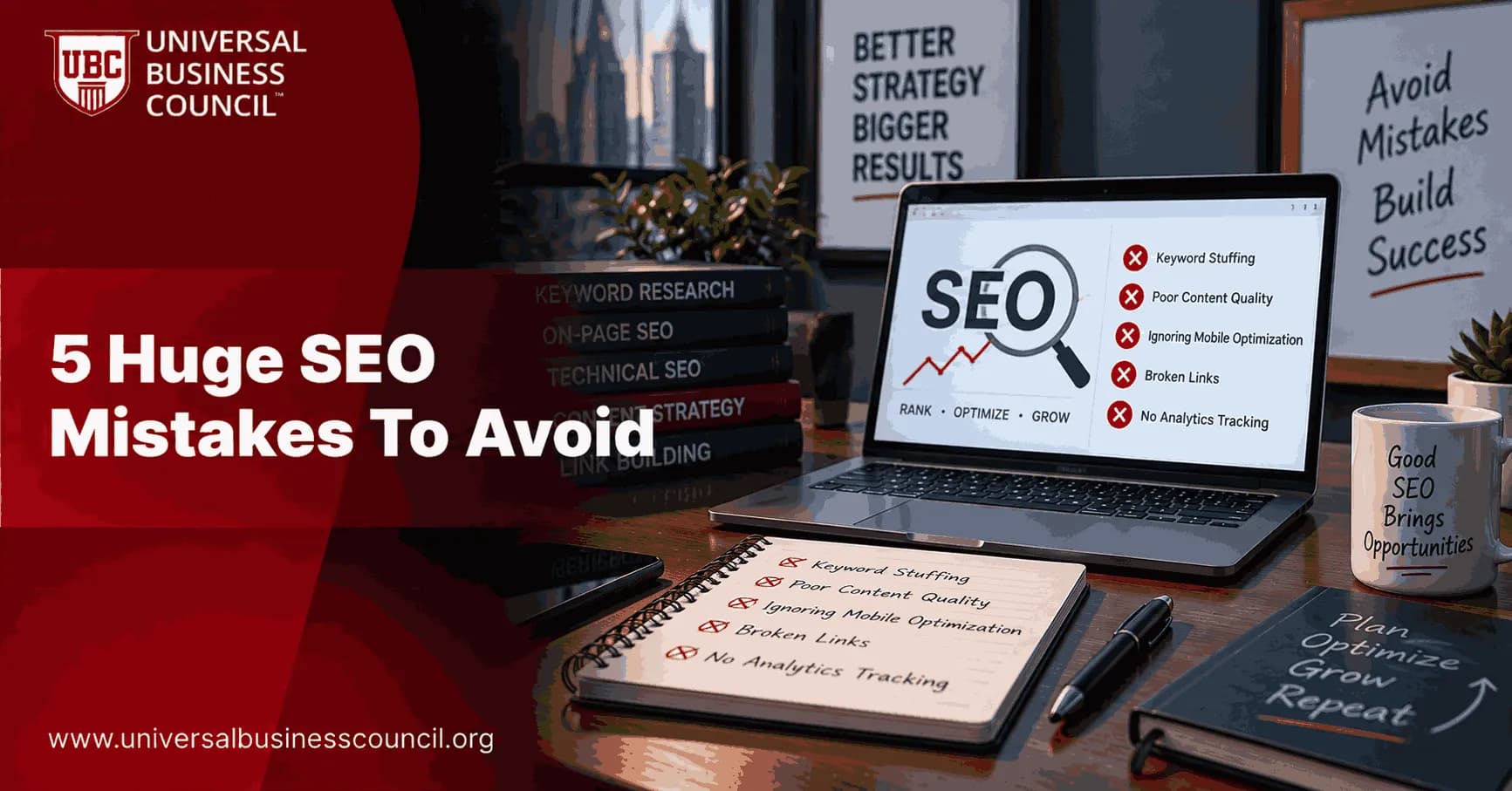
Businesses invest significant time and budget into SEO, yet many undermine their own efforts through a handful of recurring, entirely avoidable mistakes. Some of these errors are holdovers from outdated tactics that once worked but now actively harm rankings, while others stem from simply misunderstanding what modern search engines genuinely prioritize. Learning to spot and correct these mistakes early is exactly the kind of practical knowledge a Certified SEO Expert credential is built around, training professionals to recognize the specific missteps that quietly sabotage otherwise solid SEO strategies. This article breaks down five of the most damaging SEO mistakes businesses continue to make, and exactly how to avoid them.
Why These Mistakes Are So Costly
Before diving into each specific mistake, it helps to understand why SEO errors tend to compound over time rather than simply causing a minor, temporary setback.

Slow to detect: SEO issues often take weeks or months to visibly affect rankings, allowing mistakes to compound before anyone notices.
Expensive to reverse: Recovering from certain penalties or technical errors can take significantly longer than the time it took to cause them.
Compounding effects: A single mistake, like poor site structure, can quietly undermine dozens of otherwise well optimized pages at once.
Trust erosion: Search engines increasingly penalize sites that appear to manipulate rankings rather than genuinely earn them.
Understanding these stakes is exactly why avoiding these five mistakes matters considerably more than most businesses initially realize.
The 5 Huge SEO Mistakes to Avoid
1. Keyword Stuffing and Over Optimization
One of the oldest SEO mistakes still trips up businesses today, cramming keywords unnaturally into content in an attempt to rank for every possible variation of a search term.
Repeating the same keyword excessively throughout a page makes content read awkwardly and signals manipulation to search engines.
Over optimized anchor text across internal and external links can appear manipulative rather than natural.
Search engines now prioritize natural language and genuine topical relevance over rigid, exact match keyword density.
The fix involves writing naturally for readers first, incorporating keywords and related terms organically rather than forcing them into every sentence. This shift toward natural, intent driven content is central to what a Certified Digital Marketing Expert credential teaches, positioning SEO writing as part of a broader content strategy focused on genuine audience value rather than outdated mechanical tactics.
2. Ignoring Technical SEO Foundations
Even exceptional content will underperform if a website's technical infrastructure is weak, yet technical SEO remains one of the most commonly neglected areas.
Slow loading pages frustrate users and directly impact search rankings.
Poor mobile optimization hurts visibility, since most searches now happen on mobile devices.
Broken links, duplicate content, and crawl errors quietly damage a site's overall search performance.
Missing or poorly implemented structured data prevents search engines from fully understanding page content.
Regular technical audits catch these issues before they meaningfully affect rankings, yet many businesses only address technical SEO reactively, after a noticeable drop in traffic has already occurred.
3. Neglecting Content Quality for Quantity
Publishing large volumes of thin, low value content in hopes of capturing more search traffic frequently backfires, particularly as search engines increasingly prioritize genuine expertise and depth.
Short, generic articles rarely satisfy genuine search intent as effectively as thorough, well researched content.
Publishing content purely to hit a schedule, rather than to serve a genuine audience need, tends to produce forgettable, low performing pages.
Thin content across many pages can drag down a site's overall perceived quality in the eyes of search engines.
A smaller number of genuinely comprehensive, well researched pages consistently outperforms a large volume of shallow content covering the same topics.
Building Better Habits Around Technical and Strategic SEO
Avoiding these mistakes consistently comes down to treating SEO as an ongoing discipline rather than a one time setup task completed and forgotten.
Schedule regular audits: Review technical health, content performance, and backlink quality on a consistent cadence rather than only when problems arise.
Prioritize user experience: Every SEO decision should ultimately serve the person searching, not just the algorithm evaluating the page.
Stay current on algorithm changes: Search engines update their evaluation criteria frequently, and outdated assumptions can quietly undermine an otherwise solid strategy.
4. Acquiring Low Quality or Spammy Backlinks
Backlinks remain an important ranking signal, but pursuing them through low quality or manipulative methods tends to cause far more harm than benefit.
Purchasing large quantities of backlinks from low quality or irrelevant websites can trigger serious search engine penalties.
Participating in link schemes or private blog networks risks a manual penalty that can take significant time and effort to recover from.
Low quality links rarely pass meaningful authority and can actively signal manipulation rather than genuine credibility.
Ethical link building through genuine outreach, quality content, and real partnerships takes longer but produces sustainable, penalty free results.
5. Failing to Adapt to How AI Is Changing Search
Search behavior itself is evolving rapidly, and businesses that continue optimizing purely for traditional keyword rankings risk missing how search results are increasingly generated and consumed.
AI powered search increasingly surfaces direct answers rather than a simple list of ranked links.
Content that is not structured clearly for AI systems to extract and summarize risks losing visibility in these newer search formats.
Businesses that ignore Answer Engine Optimization and Generative Engine Optimization principles risk falling behind as search continues shifting toward AI generated results.
How Generative AI Is Reshaping Content Strategy Broadly
This same generative AI shift reshaping search results is also opening entirely new creative and content formats worth understanding as part of a broader, forward looking content strategy.
One emerging application is AI microdrama, where generative AI helps bring serialized stories, characters, and fictional worlds to life, illustrating how the same underlying AI technology transforming search behavior is simultaneously reshaping how audiences discover and engage with content across entirely new formats.
Building the Technical Awareness to Avoid These Mistakes
Avoiding technical SEO mistakes in particular requires genuine comfort with the tools and systems search engines increasingly rely on, including AI driven ranking factors that go well beyond simple keyword matching. A broad Tech Certification can help marketers build this kind of technical literacy, giving them the confidence to identify and correct technical issues before they meaningfully damage search performance.
Staying Ahead of Evolving SEO Standards
The mistakes covered here are not static, and what counts as an SEO best practice continues shifting as search engines incorporate more sophisticated AI and machine learning into how they evaluate content. Professionals who want to stay genuinely ahead of these changes often pursue a Deep Tech Certification, building the broader technical fluency needed to understand not just today's SEO mistakes, but the emerging pitfalls likely to matter as search technology continues to evolve.
Avoiding these five mistakes, keyword stuffing, neglected technical foundations, thin content, spammy backlinks, and failing to adapt to AI driven search, puts a business considerably ahead of competitors still relying on outdated or careless SEO practices. Consistent, honest optimization focused on genuine user value continues to outperform shortcuts, and businesses that internalize this principle early avoid the costly, slow recovery process that so often follows these very avoidable errors.
FAQs
1. What are the biggest SEO mistakes to avoid?
Five common SEO mistakes are keyword stuffing, publishing low-quality content, ignoring technical SEO, building low-quality backlinks, and failing to understand search intent. These problems can weaken a website's ability to rank and provide a useful experience for visitors.
2. Is keyword stuffing still a bad SEO practice?
Yes. Repeatedly inserting keywords unnaturally can make content difficult to read and may be considered spammy. Instead, use relevant keywords naturally while covering the topic comprehensively and addressing the user's search intent.
3. What is keyword stuffing in SEO?
Keyword stuffing is the excessive or unnatural use of keywords on a webpage in an attempt to manipulate search rankings. Modern SEO focuses more on relevance, usefulness, context, and satisfying the user's information need than on repeating an exact phrase.
4. Can low-quality content hurt SEO?
Low-quality or unhelpful content can make it harder for a website to perform well in organic search. Content should provide original value, accurate information, clear explanations, and a meaningful answer to the query it targets.
5. What is thin content, and why should I avoid it?
Thin content provides little useful information or value to the visitor. Examples can include pages with minimal original information, automatically generated pages without meaningful value, or multiple pages created primarily to target slightly different keywords.
6. Why is ignoring search intent a major SEO mistake?
Search intent describes what a person is actually trying to accomplish with a search. If your page targets the right keyword but does not satisfy the intent behind that query, it may struggle to compete with pages that provide a more appropriate answer.
7. How can I optimize content for search intent?
First determine whether the query is primarily informational, navigational, commercial, or transactional. Then examine the types of pages appearing in search results and create content that directly satisfies the user's underlying need.
8. Is ignoring technical SEO a common mistake?
Yes. Technical problems can prevent search engines from efficiently crawling, rendering, or indexing important pages. Issues involving broken links, incorrect canonical tags, poor site architecture, duplicate URLs, slow pages, or inappropriate indexing directives can all create SEO challenges.
9. Can a slow website hurt SEO?
Poor website performance can negatively affect user experience and may contribute to weaker search performance. Improving loading speed, responsiveness, and visual stability can help create a better experience for visitors.
However, technical performance should be considered alongside content relevance, quality, and other SEO factors.
10. Is poor internal linking an SEO mistake?
Yes. Weak internal linking can make it harder for users and search engines to discover related pages and understand the relationships between different parts of a website.
A logical internal linking structure can connect pillar pages with relevant supporting content and help distribute internal authority.
11. Can bad backlinks hurt SEO?
Low-quality or manipulative link-building practices can create SEO risks. Buying links intended to manipulate rankings, participating in link schemes, or generating large quantities of artificial links can violate search-engine spam policies.
Focus on earning relevant, legitimate links through valuable content, digital PR, research, and genuine relationships.
12. Should I focus only on high-volume keywords?
No. High search volume does not automatically mean high business value. Long-tail and lower-volume keywords can sometimes have clearer intent and attract visitors who are more relevant to a particular product, service, or topic.
A balanced keyword strategy should consider relevance, intent, competition, search demand, and business value.
13. What is one of the biggest AEO mistakes?
One common AEO mistake is creating content that targets questions without actually providing clear answers. If a page includes a question such as "What is technical SEO?" the answer should directly explain the concept before adding supporting detail.
Clear headings, concise answers, logical organization, and useful context can make content easier to understand.
14. How can poor content structure affect AEO?
Poorly structured content can make it harder for users and automated systems to identify the main answer. Use descriptive headings, short paragraphs, lists where appropriate, definitions, FAQs, and clearly separated sections to organize information.
15. What GEO mistake should businesses avoid?
A major GEO mistake is assuming that simply adding AI-related keywords will make content appear in generative search results. GEO is better approached through accurate, authoritative, well-structured, entity-rich content that provides useful information and can be understood in context.
16. Should I create separate pages for every keyword?
Not necessarily. Creating many pages that target nearly identical keywords can lead to overlapping content and an unnecessarily complicated website.
Instead, group closely related queries by search intent and create a strong page when one resource can satisfy those needs effectively.
17. Can duplicate content cause SEO problems?
Duplicate or substantially similar content can make it harder for search engines to determine which version should be surfaced. Websites should use appropriate canonicalization, redirects, and content organization when multiple URLs contain similar information.
Not every instance of duplicate content is automatically a penalty, but unnecessary duplication can create indexing and ranking challenges.
18. Is ignoring SEO analytics a mistake?
Yes. Without measurement, it is difficult to determine which SEO activities are producing meaningful results. Monitor metrics such as organic clicks, impressions, conversions, landing-page performance, indexing, rankings, and relevant engagement signals.
19. What are the warning signs of poor SEO?
Some warning signs include:
Sudden unexplained organic traffic declines
Many important pages not being indexed
Large numbers of broken links
Unnatural backlink growth
Keyword rankings without meaningful conversions
Duplicate or thin pages
Poor mobile experience
Content that does not match search intent
Declining visibility for important topics
These signals should be investigated rather than automatically attributed to a single SEO issue.
20. What are the 5 huge SEO mistakes to avoid?
The five core mistakes are:
Keyword stuffing instead of writing naturally for users.
Publishing thin or unhelpful content without providing genuine value.
Ignoring technical SEO and allowing crawling, indexing, performance, or site-structure problems to persist.
Using manipulative or low-quality link-building tactics instead of earning relevant authority.
Ignoring search intent, AEO, and evolving search experiences, resulting in content that does not directly answer what users are looking for.
Avoiding these mistakes creates a stronger foundation for SEO, AEO, and GEO, while keeping the primary focus on useful, accurate, and accessible content.
Related Articles
View All
Digital Marketing
Common Google Ads Mistakes and How to Avoid Them in 2026
Avoid costly Google Ads mistakes with better conversion tracking, negative keywords, intent targeting, landing page alignment, and smarter automation governance.
Digital Marketing
Building an AI-Ready Content Strategy with SEO, GEO, and AEO
Learn how to build an AI-ready content strategy by integrating SEO, GEO, and AEO to improve search visibility, AI citations, and trusted answers.

Digital Marketing
The Role of AI in SEO: Smarter Keyword Research, Content Optimization, and Ranking Insights
Learn how AI in SEO improves keyword research, content optimization, ranking insights, and AI search visibility for modern digital marketing teams.
Trending Articles
The Role of Blockchain in Ethical AI Development
How blockchain technology is being used to promote transparency and accountability in artificial intelligence systems.
AWS Career Roadmap
A step-by-step guide to building a successful career in Amazon Web Services cloud computing.
Top 5 DeFi Platforms
Explore the leading decentralized finance platforms and what makes each one unique in the evolving DeFi landscape.