

Research & Knowledge Hub
1,139+ research articles, technical guides, and in-depth analyses authored by council members and industry experts.
Articles - Page 2
1,139 articles
How Should a Chief AI Officer Manage AI Vendors?
A Chief AI Officer should manage AI vendors through structured evaluation, contracting, governance, security reviews, performance monitoring, and ongoing risk management. Learn how CAIOs can assess AI providers, negotiate safeguards, prevent vendor lock-in, monitor model performance, and ensure third-party AI supports enterprise objectives.
Build vs Buy AI: What Should Enterprises Choose?
The build vs buy AI decision depends on an enterprise's strategic needs, internal expertise, data requirements, customization demands, cost, speed, and risk tolerance. Learn when organizations should build AI capabilities internally, buy commercial solutions, or adopt a hybrid approach.
How to Choose the Right AI Model for an Enterprise
Choosing the right AI model for an enterprise requires balancing business requirements with accuracy, cost, latency, security, privacy, scalability, and integration needs. Learn how to evaluate proprietary and open models, benchmark them against real workloads, and select models based on measurable business outcomes rather than leaderboard scores alone.

How Should Companies Deploy LLMs?
Companies should deploy large language models through a structured approach that balances business value, performance, security, cost, and governance. Learn how enterprises can choose between hosted APIs, managed platforms, and self-hosted models, prepare data, implement safeguards, evaluate outputs, and monitor LLMs in production.
How to Build an Enterprise AI Agent Strategy
An enterprise AI agent strategy defines how organizations can identify, deploy, govern, and scale agentic AI across business operations. Learn how to prioritize high-value agent use cases, design the right architecture, establish permissions and human oversight, manage security risks, and measure business outcomes.
How AI Agents Are Changing Enterprise Operations
AI agents are changing enterprise operations by automating multi-step workflows, coordinating tasks across business systems, supporting employees, and making certain decisions with greater autonomy. Explore how agentic AI is transforming areas such as customer service, IT, finance, HR, sales, and supply chain operations.
AI Agents vs AI Copilots for Business
AI agents and AI copilots can both improve business productivity, but they operate at different levels of autonomy. AI copilots primarily assist employees with tasks and decisions, while AI agents can plan, execute multi-step workflows, use tools, and take actions with less human involvement.
How Should a Chief AI Officer Manage AI Agents?
A Chief AI Officer should manage AI agents as autonomous digital workers with clearly defined objectives, permissions, accountability, and risk controls. Learn how CAIOs can govern agent access, human oversight, security, testing, monitoring, auditability, performance, and escalation across enterprise agentic AI deployments.
How Should Enterprises Adopt Generative AI?
Enterprises should adopt generative AI through a structured approach that connects high-value business use cases with secure technology, reliable data, governance, and workforce readiness. Learn how organizations can move from GenAI pilots to scalable deployment while controlling costs, risks, and measuring business outcomes.
Generative AI Strategy for Enterprises
A generative AI strategy helps enterprises move beyond scattered experiments and apply GenAI to measurable business priorities. Learn how to identify high-value use cases, select models and platforms, prepare enterprise data, establish governance and security, drive workforce adoption, and measure business impact.
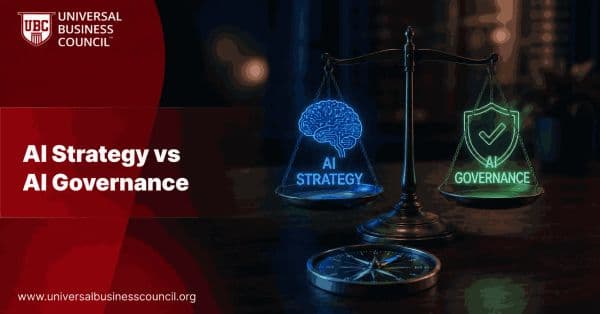
AI Strategy vs AI Governance
AI strategy and AI governance address different but interconnected aspects of enterprise AI. AI strategy defines where and how an organization will use AI to create business value, while AI governance establishes the policies, accountability, controls, and oversight needed to ensure those initiatives operate responsibly and within acceptable risk.
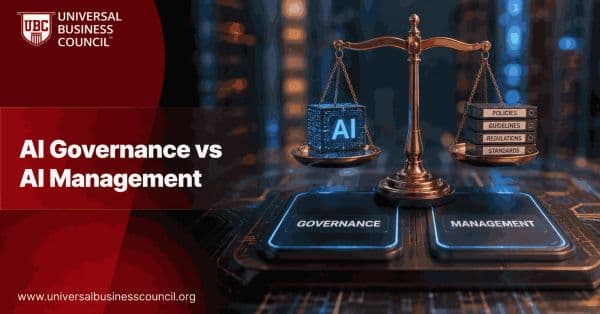
AI Governance vs AI Management
AI governance and AI management are closely connected but serve different purposes. AI governance defines the policies, accountability, risk boundaries, and oversight for artificial intelligence, while AI management focuses on executing those requirements through day-to-day processes, controls, monitoring, and operations.